Key Factors Driving Startup Success in the Digital Age
- Mira roy
- Nov 28, 2025
- 3 min read

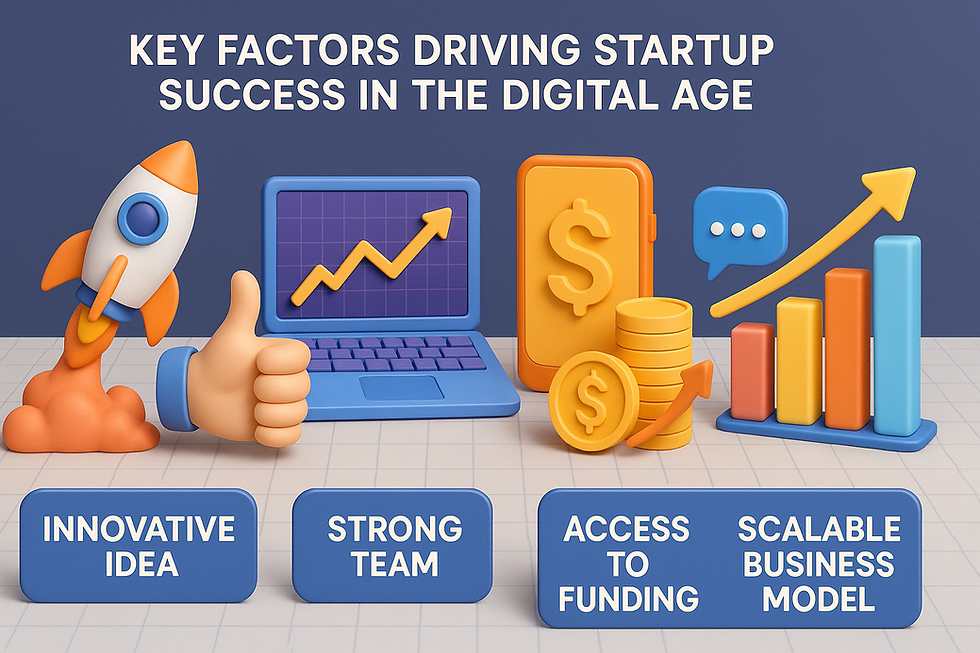
Launching a startup today is both more exciting—and more challenging—than ever before. With digital tools, global markets, and AI-driven operations at our fingertips, entrepreneurs have endless opportunities to scale quickly. Yet the same digital landscape also brings intense competition, fast-changing consumer behavior, and constant technological evolution.
To help founders navigate this environment, here are the key factors driving startup success in the digital age, backed by industry trends and realistic insights.
1. A Clear Value Proposition
In a crowded digital marketplace, clarity wins. Successful startups can explain what they do—and why it matters—in one or two sentences. Consumers make decisions fast, so your offering needs to instantly communicate value.
Tips:
Focus on solving a real problem.
Highlight what makes you different from existing solutions.
Test your message with real users before going to market.
2. Digital-First Business Models
Today, most thriving startups adopt digital-first strategies. That means prioritizing online channels for sales, marketing, and customer engagement.
Examples of digital-first approaches include:
E-commerce or subscription-based revenue models
Mobile-first user experiences
Cloud-based service delivery
Remote-first team structures
Recent industry analyses show that over 60% of new businesses incorporate at least one digital revenue stream, a number that continues to grow as consumers shift online.
3. Data-Driven Decision Making
Startups no longer need large research teams to understand customer behavior. Affordable analytics tools provide real-time insights that help founders refine products and marketing strategies.
Key data areas to track:
Customer acquisition costs (CAC)
User engagement and retention
Website and app behavior analytics
Conversion rates across channels
Feedback and reviews
Companies that integrate data into decision-making early tend to scale faster and pivot more effectively.
4. Strong Online Presence & Branding
Digital visibility is essential. Even the best idea struggles without strong branding and a compelling online presence.
Invest in:
A professional website (Wix makes this fast and scalable)
Search engine optimization (SEO)
Active social media engagement
Consistent brand messaging
Authentic storytelling
Studies from marketing surveys suggest that brands with consistent visual identity across channels can increase revenue by 20–25%—a powerful advantage for startups.
5. Customer-Centric Design
Users expect seamless digital experiences. Startups that prioritize UX/UI design gain loyalty and positive word-of-mouth—two free but powerful growth drivers.
Consider:
Mobile responsiveness
Fast loading speeds
Simple navigation
Personalization powered by AI
Accessible design for all users
Even small UX improvements can dramatically improve conversion rates.
6. Agile Operations & Rapid Iteration
The digital age rewards adaptability. Agile startups iterate quickly, launch minimum viable products (MVPs), gather feedback, and refine.
Why agility matters:
Faster response to market changes
Reduced risk through continuous testing
Clearer path from prototype to product-market fit
Many successful digital startups report releasing new updates weekly or biweekly during early-stage growth.
7. Smart Use of Automation & AI
AI is no longer a luxury—it’s a competitive necessity. It helps startups cut costs, operate efficiently, and deliver personalized customer experiences.
Popular AI applications include:
Automated customer support (chatbots)
Predictive analytics
Automated marketing workflows
Smart inventory and logistics management
AI-assisted content creation
Startups using automation report saving up to 30% on operational costs, according to multiple business process studies.
8. Strong Teams & Digital Skills
Behind every successful startup is a well-rounded team. In the digital age, talent with hybrid skills—such as marketing + data analytics or design + coding—creates a major competitive edge.
Important startup skill sets:
Software development
Digital marketing
Data analysis
UX/UI design
Product management
Remote work also allows founders to hire global talent without increasing overhead.
9. Access to Funding & Scalable Tools
Capital still matters, but how startups use it matters even more. Cloud tools, subscription software, and flexible digital platforms allow founders to scale efficiently without massive upfront investments.
Useful scalable tools include:
Website builders like Wix
Cloud hosting
CRM systems
Project management tools
No-code automation platforms
Conclusion
Startup success in the digital age comes from embracing technology, staying agile, and delivering value that aligns with today’s fast-moving consumer habits. With the right combination of data, digital tools, and customer-focused design, any ambitious founder can build a brand that stands out—and scales rapidly.
If you’re ready to leverage the full potential of AI in your startup journey, explore our Generative AI Professional Certification Training to future-proof your skills and drive smarter innovation.


Comments