Understanding Scalability and High Availability in the Cloud
- Mira roy
- Jan 6
- 3 min read

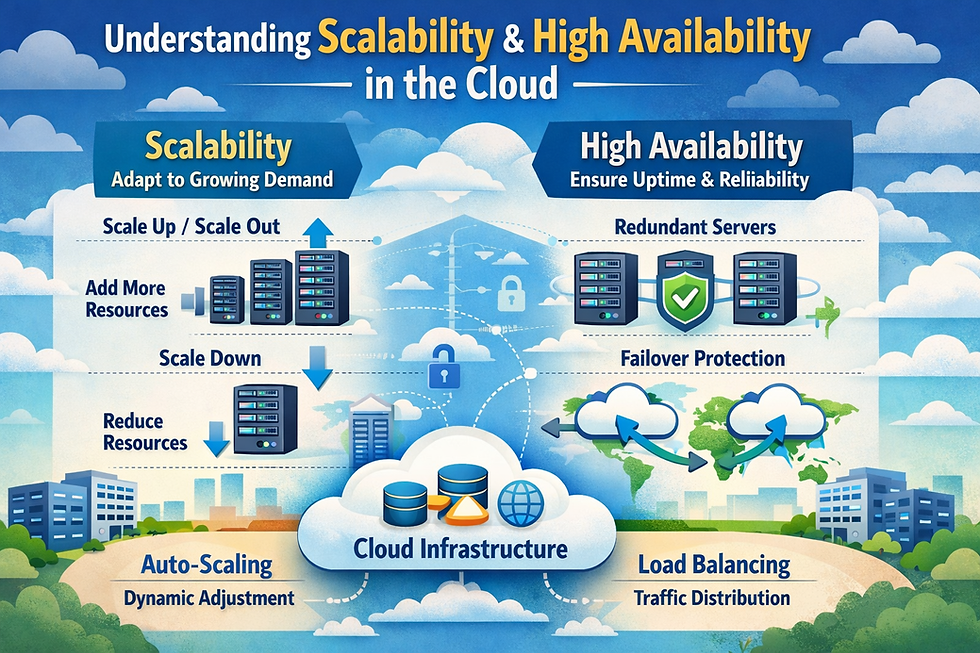
In today’s digital-first world, businesses are increasingly relying on cloud computing to host applications, manage data, and deliver services. Two of the most crucial concepts in cloud architecture are scalability and high availability. Understanding these concepts is essential for organizations that want to build resilient, efficient, and cost-effective cloud solutions.
Scalability in the Cloud
Scalability refers to a system’s ability to handle increased workload without compromising performance. In the cloud, scalability is achieved by adding resources dynamically to meet demand. There are two main types of scalability:
Vertical Scalability (Scaling Up): This involves increasing the capacity of existing servers or instances, such as adding more CPU, memory, or storage. For example, upgrading an Amazon EC2 instance from t3.medium to t3.2xlarge allows a web application to handle higher traffic. Vertical scaling is straightforward but has hardware limits and can be expensive.
Horizontal Scalability (Scaling Out): This involves adding more instances or nodes to distribute the workload. For instance, a web application hosted on AWS Auto Scaling can spin up additional EC2 instances when traffic spikes. Horizontal scaling is more flexible and cost-efficient in the long term because it allows the system to expand almost indefinitely.
Cloud providers offer tools to manage scalability automatically:
AWS Auto Scaling adjusts compute resources based on real-time demand.
Microsoft Azure Scale Sets allow automatic scaling of virtual machines.
Google Cloud Compute Engine can dynamically add instances depending on traffic patterns.
Statistics indicate that companies leveraging scalable cloud infrastructure can handle traffic surges more effectively. According to a 2023 Gartner report, organizations that implemented automated scaling in the cloud experienced up to 50% improvement in response time during peak periods.
High Availability in the Cloud
High availability (HA) is the ability of a system to remain operational and accessible even during failures. In the cloud, HA is achieved by eliminating single points of failure and distributing workloads across multiple resources and locations. Key strategies include:
Redundancy: Duplicating critical components such as servers, storage, and network links ensures that if one component fails, another can take over without interruption. For example, storing data in multiple AWS Availability Zones ensures access even if one zone goes down.
Load Balancing: Distributing traffic evenly across multiple servers prevents overload on a single instance. Tools like AWS Elastic Load Balancer or Azure Load Balancer can automatically route traffic to healthy instances.
Failover Mechanisms: Automatic failover redirects requests to backup systems in case of a failure. For mission-critical applications, failover can reduce downtime from hours to minutes.
According to Uptime Institute, organizations with cloud-based high availability strategies experience 99.99% uptime on average, which translates to less than 52 minutes of downtime per year.
Also read: AWS Solutions Architect Associate Study Guide (SAA-C03): Proven Tips to Pass on Your First Try
Why Scalability and High Availability Matter
Improved User Experience: Applications can handle sudden spikes in traffic without crashing, ensuring smooth access for users.
Cost Efficiency: Cloud platforms allow organizations to pay for resources on-demand, avoiding over-provisioning while still maintaining capacity during peak times.
Business Continuity: High availability minimizes downtime, protecting revenue and brand reputation.
Flexibility for Growth: Scalable architecture supports business expansion without costly infrastructure overhauls.
Real-World Example
Consider a streaming service like Netflix. During popular show releases, traffic can spike dramatically. Netflix uses horizontal scaling with thousands of servers distributed across global data centers to ensure smooth streaming. Load balancers distribute user requests efficiently, and high availability strategies prevent interruptions even if a server fails. This combination of scalability and HA allows Netflix to serve over 230 million subscribers seamlessly.
Conclusion
Scalability and high availability are not optional in modern cloud architecture—they are essential for building resilient, efficient, and user-friendly systems. Scalability ensures that your applications can grow with demand, while high availability guarantees that users can access your services without interruption. Leveraging cloud-native tools and best practices can help businesses optimize costs, improve performance, and maintain trust with their users. Organizations that invest in both scalability and HA are better positioned to succeed in an increasingly digital and competitive landscape.
Mastering cloud concepts like scalability and high availability is a key step toward advancing your career, and the AWS Solution Architect Associate Certification Course and Training provides the practical skills to design robust, scalable, and highly available cloud solutions.


Comments