Key Differences Between PMP and Agile Certifications
- Mira roy
- Nov 6, 2025
- 3 min read

In today’s dynamic business environment, project management has evolved into one of the most in-demand career paths across industries. With organizations striving to deliver projects faster, more efficiently, and with higher customer satisfaction, certified project managers are increasingly valuable. Among the most recognized certifications are Project Management Professional (PMP) and Agile certifications such as Certified ScrumMaster (CSM) or PMI-ACP (Agile Certified Practitioner).
While both PMP and Agile certifications enhance project management skills, they differ significantly in approach, methodology, and application. Let’s explore the key differences to help professionals choose the right path for their career goals.
1. Methodology and Approach
PMP (Project Management Professional)
Based on the PMBOK (Project Management Body of Knowledge) developed by the Project Management Institute (PMI).
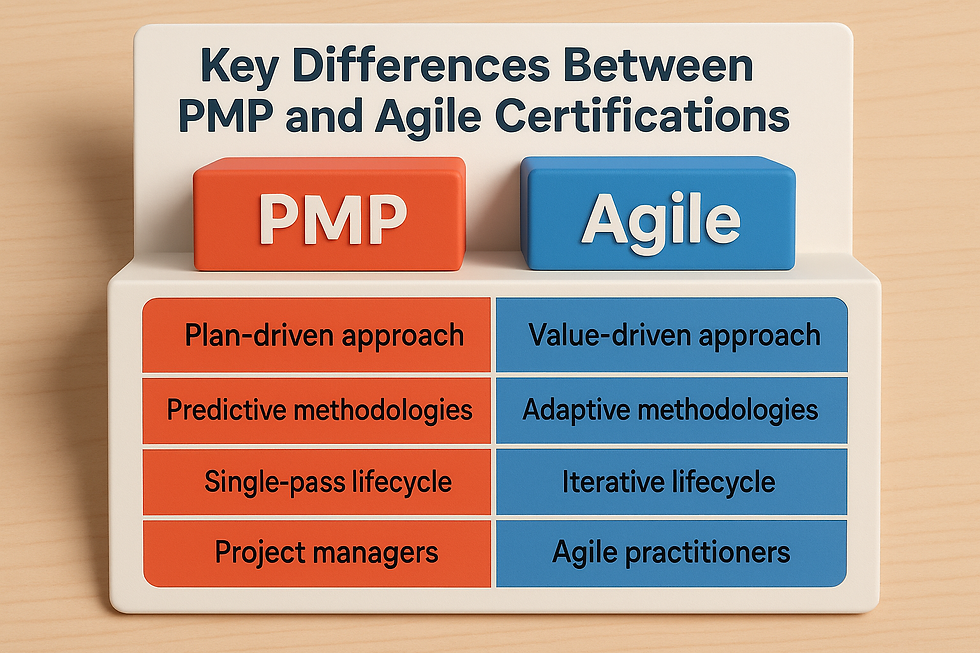
Follows a predictive or traditional (Waterfall) approach where planning, execution, and delivery occur in sequential phases.
Emphasizes structured project management processes, documentation, and stakeholder control.
Agile Certifications (e.g., CSM, PMI-ACP, SAFe Agilist)
Focus on iterative and adaptive project management frameworks.
Agile methodologies like Scrum, Kanban, and Lean encourage flexibility and collaboration.
Projects are divided into short cycles or sprints, allowing for regular feedback and continuous improvement.
In essence: PMP focuses on control and predictability, while Agile emphasizes adaptability and collaboration.
2. Certification Focus
PMP Certification
Recognizes professionals skilled in managing large-scale, complex, and structured projects.
Covers 49 processes grouped into five process groups—Initiating, Planning, Executing, Monitoring & Controlling, and Closing.
Suitable for industries like construction, defense, manufacturing, and IT infrastructure.
Agile Certifications
Concentrate on team collaboration, rapid delivery, and customer satisfaction.
Common Agile certifications include:
Certified ScrumMaster (CSM) – Focuses on Scrum principles.
PMI-ACP – Blends multiple Agile frameworks.
Professional Scrum Master (PSM) – Offered by Scrum.org for in-depth Scrum knowledge.
Best suited for software development, marketing, and product innovation sectors.
Unlock your project management potential with our “PMP Certification Requirements – A Complete Guide” — your one-stop resource to qualify, prepare, and get certified with confidence!
3. Exam Format and Eligibility
PMP Exam:
Eligibility:
Bachelor’s degree + 36 months of project management experience, or
High school diploma + 60 months of experience.
35 hours of formal project management education required.
Exam Details:
180 questions, 230 minutes.
Covers predictive, hybrid, and Agile topics.
Pass Rate: Estimated at 60–70% globally.
Agile Certification Exams (e.g., CSM):
Eligibility: Generally open to all; experience not always required.
Exam Details:
CSM: 50 questions, 60 minutes.
PMI-ACP: 120 questions, 180 minutes.
Easier entry point for beginners compared to PMP.
4. Career Impact and Salary Trends
According to the PMI Salary Survey (2023):
PMP-certified professionals earn an average of 22% higher salaries than their non-certified peers.
In the U.S., PMP holders earn around $120,000–$130,000 annually, while Agile-certified professionals average $110,000–$125,000, depending on their role and experience.
Industry Preference:
PMP: Ideal for roles like Project Manager, Program Manager, and PMO Lead.
Agile: Best for Scrum Masters, Product Owners, and Agile Coaches.
Example:A project manager in a construction firm may prefer PMP for structured execution, while a product manager in a software startup might benefit more from CSM or PMI-ACP.
5. Global Recognition and Demand
PMP is recognized in over 200 countries, with over 1.5 million active holders worldwide.
Agile certifications are growing rapidly, especially in tech-driven industries. The Scrum Alliance alone reports over 1 million CSM holders globally.
Both certifications are highly respected, but PMP holds more universal appeal, while Agile dominates digital and IT sectors.
6. Choosing the Right Certification
When deciding between PMP and Agile, consider the following:
Project Environment: Predictive (choose PMP) vs. Adaptive (choose Agile).
Industry Type: Traditional industries prefer PMP; fast-paced, innovative sectors favor Agile.
Career Goals: If you aim for leadership roles or enterprise-level project management, PMP is ideal. For roles emphasizing team collaboration and iterative delivery, Agile is the better choice.
Final Thoughts
Both PMP and Agile certifications significantly boost your career prospects, credibility, and earning potential. However, the best certification depends on your career path, work environment, and long-term goals. In fact, many professionals today pursue both certifications to gain a comprehensive understanding of hybrid project management—balancing the rigor of PMP with the flexibility of Agile. Take the next step in your project management journey with our expert PMP training and courses designed to turn your experience into certification success.
In the modern workplace, versatility is key. Whether you’re managing large infrastructure projects or leading a cross-functional product team, being well-versed in both PMP and Agile methodologies ensures you stay relevant and ahead in your project management career.


Comments